
Choosing a care home for someone you love is about more than comparing rooms, fees and inspection reports. You want to know they will still feel like themselves there.
For a Muslim resident, this may mean having halal food, somewhere to pray, support during Ramadan and care that respects modesty and other religious and cultural preferences.
You don’t necessarily need to find an exclusively Muslim care home. A mainstream residential or nursing home can be Muslim-friendly if it understands, respects and supports the person’s individual needs.
The important thing is not whether a home calls itself “Muslim-friendly”, but whether it can show you what that means in practice.
Page contents
- What makes a care home Muslim-friendly?
- Start with the person, not the care home
- Halal food: Don't accept a one-word answer
- Salah and Wudu: Think about the practicalities
- Modesty and same-gender personal care
- Ramadan and Eid need a conversation of their own
- What about an imam or mosque?
- Don't let “Muslim-friendly” distract you from quality
- Visit before you decide
- The Muslim-friendly care home questions to take with you
- How to find Muslim-friendly care homes near you
- The right care home should make room for the whole person
- Looking for the right care home?
- FAQs
 At a glance
- Muslim-friendly care: A care home does not have to be Muslim-owned, but it should understand and respect a resident’s religious, cultural and personal preferences.
- Halal food: Check how halal food is sourced, stored and prepared, and whether it is available consistently.
- Prayer and personal care: Ask how the home supports Salah and Wudu, and whether it can accommodate preferences for same-gender carers.
- Ramadan and Eid: Find out how the home supports residents who wish to observe Ramadan and celebrate Eid.
What makes a care home Muslim-friendly?
There is no single badge that makes a care home suitable for Muslims.
Instead, think about the everyday details.
A Muslim care home in the UK should be willing and able, where reasonably possible, to accommodate halal dietary requirements, Salah, Wudu, modesty, preferences around personal care, Ramadan and Eid, religious visitors, and connections with the wider Muslim community.
This fits with how person-centred care should be delivered more broadly. In England, the Care Quality Commission (CQC) guidance on culturally appropriate care says cultural identity can include religion and that people’s religious and cultural needs should be considered when planning care, meals, activities and end-of-life support.
Scotland, Wales and Northern Ireland have their own care regulators, but wherever your loved one lives in the UK, ask how their religious, cultural and personal preferences will be understood, recorded and respected.
So no, an Islamic care home does not have to be Muslim-owned. And a Muslim resident does not necessarily need to live in a home where every other resident is Muslim.
What matters is whether your loved one’s needs will be understood, recorded and respected.
Start with the person, not the care home
Before searching for Muslim residential care, write down what actually matters to the person who will be living there.
Perhaps your mother needs halal meals but doesn’t need help with prayer.
Perhaps your father wants to attend Friday prayers whenever possible but needs assistance with mobility.
Perhaps your grandmother places particular importance on having a female carer for intimate personal care.
These are very different requirements.
That means there is no reason to treat choosing a care home as a one-size-fits-all exercise. The right question is not simply, “Does this home look good?”
It is:
“Can this home care for this particular person well?”
Halal food: Don’t accept a one-word answer
“Do you provide halal food?”
“Yes.”
It sounds reassuring. It tells you almost nothing.
Ask where the meat is sourced, how it is stored, how it is prepared and how the kitchen prevents cross-contamination where relevant. Ask whether halal options are available consistently rather than only when specifically requested.
You can also ask to see a sample menu.
This matters beyond religious observance. In England, CQC’s Regulation 14 guidance says providers must take people’s nutritional needs, preferences and religious and cultural backgrounds into account when providing food and drink.
So ask about the details that disappear behind the word halal: breakfast, desserts, snacks, sauces, drinks and special occasions.
And ask what happens when the usual chef is off duty.
A dietary requirement is only being respected if the system works when nobody is standing over it.







Salah and Wudu: Think about the practicalities
Prayer may be straightforward for one resident and considerably more complicated for another.
Ask whether there is a clean, quiet and private place for Salah. It does not necessarily need to be a dedicated prayer room. A suitable private space may be perfectly adequate.
Then think beyond the room.
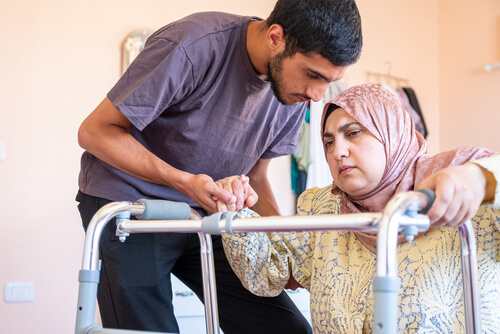
Can the resident get there independently? If not, can staff assist? Can they keep a prayer mat and Qur’an safely? Can their preferred prayer routine be recorded in their care plan?
Wudu deserves the same practical conversation.
If your loved one needs assistance with Wudu because of mobility, continence or other care needs, ask the provider exactly what support can be offered and how it would fit into the person’s care plan.
Don’t assume staff will automatically know what is required.
Tell them. Ask them. Then ask how they would put it into practice.
Modesty and same-gender personal care
For some Muslim residents, having a male or female carer for intimate personal care may be an important part of maintaining dignity.
This is one of those questions families sometimes feel uncomfortable asking.
Ask it anyway.
Can the home accommodate a preference for same-gender carers? What happens if the preferred carer is unavailable? How is the preference communicated between shifts? Is it written into the care plan?
In England, the CQC specifically links culturally appropriate care with dignity, respect, consent and person-centred care. It also expects providers to identify and reflect people’s cultural and religious preferences in their care.
A provider should not promise something it cannot realistically deliver.
Honesty is better than reassurance that falls apart at 2 a.m.
Ramadan and Eid need a conversation of their own
Ramadan can change the rhythm of a person’s day.
Meals may need to be considered differently. Religious routines may change. Family visits may become particularly meaningful. Eid can bring another opportunity for celebration and connection.
But there is an important line here: fasting is not simply a lifestyle preference when an older person has health conditions or takes medication.
If a resident wants to fast, the care home should discuss the person’s wishes and care needs appropriately with them, their representative and relevant healthcare professionals. Families should not assume that fasting is medically appropriate—or inappropriate—without considering the individual’s circumstances.
The same principle applies to medication schedules, hydration and nutrition.
For Eid, ask whether the home can support meaningful celebration through family visits, suitable food, clothing, activities or religious observance.
It doesn’t have to be elaborate.
Sometimes having someone say, “Eid Mubarak” and making space for the family to celebrate together is the difference between feeling accommodated and feeling at home.
What about an imam or mosque?
Your chosen care home does not need to have an imam on payroll.
Instead, ask whether an imam or local Muslim religious representative can visit residents.
Also investigate the surrounding community.
Is there a mosque nearby? Could family members take the resident there where appropriate? Does the home have relationships with local Muslim organisations?
This can become particularly important as a person spends more time in residential care. Their connection with family, friends, faith and community should not disappear simply because their address has changed.
Don’t let “Muslim-friendly” distract you from quality
This may be the most important part of the entire decision.
Halal food is essential if your loved one requires it. A prayer space may be important. Cultural understanding matters. But none of these should compensate for poor care.
Check the home’s inspection history, staffing, safety, cleanliness, responsiveness, leadership and approach to dignity.
Care homes are regulated separately in each UK nation, so check the latest inspection information from the relevant regulator:
- England: The Care Quality Commission (CQC) regulates care homes and publishes inspection information and ratings.
- Scotland: The Care Inspectorate regulates and inspects care services, including care homes.
- Wales: Care Inspectorate Wales (CIW) registers, regulates and inspects care services.
- Northern Ireland: The Regulation and Quality Improvement Authority (RQIA) regulates and inspects residential and .
Provides 24-hour care from qualified nurses, alongside accommodation and personal care, for individuals with complex medical needs, severe disabilities, or chronic illnesses.
Whichever part of the UK you are searching in, religious and cultural considerations should form part of a wider assessment of whether the home can provide safe, high-quality and person-centred care.
Download your free care home funding guide
Visit before you decide
A website can tell you that a care home is “warm”, “welcoming” and “person-centred”.
The residents will tell you more.
Visit.
Watch how staff speak to people. Do they knock before entering rooms? Do they call residents by their preferred names? Do residents appear clean, comfortable and engaged?
Look at the dining room.
Ask what today’s lunch is.
Look at the activities board.
Listen to the noise level.
And then ask the questions that matter specifically to your family.
You are not being difficult.
You are doing due diligence for someone’s home.
The Muslim-friendly care home questions to take with you
Save this list on your phone before your next viewing:
- Do you provide halal meals every day?
- Where do you source your halal food?
- How is halal food stored and prepared?
- How do you manage cross-contamination?
- Is there a suitable private space for Salah?
- Can staff assist with Wudu where required?
- Can same-gender personal-care preferences be accommodated?
- How are religious preferences recorded in the care plan?
- How do you support residents who wish to observe Ramadan?
- How would you manage care routines if a resident wishes to fast?
- How do you celebrate or accommodate Eid?
- Can an imam visit the home?
- Is there a mosque nearby?
- Can residents maintain contact with their existing Muslim community?
- How are religious and cultural preferences communicated between staff shifts?
- How are religious wishes considered in end-of-life care?
- What happens if you cannot accommodate a particular request?
That last question is surprisingly useful.
A trustworthy provider will tell you where its boundaries are.
How to find Muslim-friendly care homes near you
Finding a Muslim-friendly care home near you may take a little research, as a home does not have to describe itself as Islamic or Muslim-friendly to provide suitable care.
Start by searching for care homes in your local area and make a shortlist of those that can meet your loved one’s care needs. Check their latest inspection information and reviews, as well as the type of care they provide.
You can also check the home’s latest inspection information with the relevant regulator: the CQC in England, Care Inspectorate in Scotland, Care Inspectorate Wales (CIW) in Wales or RQIA in Northern Ireland.
Then contact the homes directly and ask how they would support your loved one’s religious and cultural preferences. This could include halal food, Salah and Wudu, same-gender personal care, Ramadan and Eid, visits from an imam and links with the local Muslim community.
It can also be helpful to:
- Visit the care home: Meet the manager and staff and ask to see facilities such as dining areas and suitable spaces for prayer.
- Speak to local Muslim organisations: Mosques, Islamic centres and community groups may know of care homes that already support Muslim residents.
- Ask about individual care plans: Check that important religious and cultural preferences can be recorded and communicated to everyone involved in your loved one’s care.
- Look beyond labels: A mainstream care home that understands and respects your loved one’s faith may be a better choice than one that describes itself as “Muslim-friendly”.
Most importantly, choose a care home that can demonstrate how it will provide safe, high-quality care while respecting your loved one’s faith, culture and individual preferences.
The right care home should make room for the whole person
Choosing a Muslim-friendly care home is not about finding a place that simply ticks “halal food” and “prayer facilities” on a brochure.
It is about finding somewhere that sees the person behind the care needs.
Someone with routines. Beliefs. Favourite foods. A way of praying. A sense of modesty. Memories of Eid mornings. Familiar faces from the mosque. A life they should not have to leave behind simply because they now need more support.
So, ask the detailed questions. Check the care home’s quality and inspection history. Visit more than once. Notice how staff speak to residents when they think nobody is evaluating them. And don’t be afraid to ask a provider, “How exactly would you support my mother? My father? My husband?”
The right answer should never be a vague “Don’t worry, we will take care of everything.”
It should be specific.
Because choosing care is not just about finding somewhere your loved one can live.
It is about finding somewhere they can continue living as themselves.
Looking for the right care home?
Finding a care home that meets both your loved one’s care needs and their religious and cultural preferences can take time. Start by comparing suitable homes in your area, checking their latest inspection information and speaking directly with providers about what matters most to your family.
Next steps
- Decide what matters most: Write down your loved one’s care, religious and cultural needs, including halal food, prayer and personal care preferences.
- Search carehome.co.uk: Use carehome.co.uk to find care homes near you, compare suitable options and read reviews from residents and their families.
- Ask specific questions: Speak to shortlisted homes about how they would support your loved one’s faith, routines and individual preferences.
- Visit before deciding: Meet the staff, look around the home and make sure it feels like somewhere your loved one could be comfortable, respected and well cared for.
FAQs
What is the most important thing to check when choosing Muslim elderly care?
Think in two layers: quality of care and religious compatibility. First, check registration, inspection reports, staffing, safety, dignity and the home’s ability to meet the resident’s care needs. Then assess halal food, prayer, modesty, same-gender care, Ramadan, community links and religious preferences. The right home should be able to explain how both layers will work together.
Are there dedicated Islamic care homes in the UK?
Yes, some care providers specifically market their services to Muslim residents, while many mainstream care homes accommodate Muslim residents without being exclusively Islamic. Availability varies significantly by location. Families should compare each home’s actual services rather than relying on its marketing, particularly regarding halal food, Salah, personal care, Ramadan support and access to Muslim community resources.
Does a care home have to be Muslim-owned to be Muslim-friendly?
No. A care home does not have to be Muslim-owned or exclusively serve Muslim residents. What matters is whether it can provide safe, high-quality, person-centred care while respecting the resident’s religious, cultural, dietary and personal preferences. Ask the provider to explain exactly how they would incorporate those needs into the individual’s care plan.