Alzheimer’s smells like rye bread, cancer like mushrooms and diabetes like nail polish, says Joy Milne, who sniffed out her husband’s Parkinson’s Disease 12 years before he had received a Parkinson’s diagnosis.
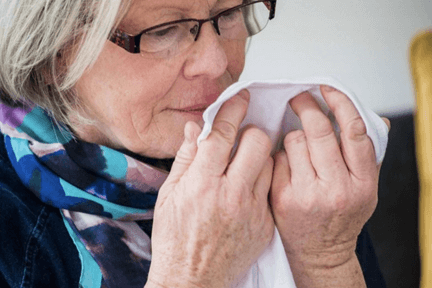
Joy Milne. Credit: Joy Milne
Page contents
- At a glance
- The woman who smelled Parkinson's
- What are the symptoms of Parkinson’s disease?
- How common is Parkinson’s?
- What causes Parkinson’s?
- What is hyperosmia?
- Told to stay quiet and not use super smell
- What did her husband Les smell like when she first met him?
- What does this mean for family and carers?
- What effect did Parkinson’s have on Les’ character?
- What’s it like to care for someone with Parkinson’s?
- How is Parkinson's diagnosed? Joy's test
- Is Joy’s sense of smell more powerful than a trained animal?
- 'I did score higher than the rat'
- FAQs
Page contents
- At a glance
- The woman who smelled Parkinson's
- What are the symptoms of Parkinson’s disease?
- How common is Parkinson’s?
- What causes Parkinson’s?
- What is hyperosmia?
- Told to stay quiet and not use super smell
- What did her husband Les smell like when she first met him?
- What does this mean for family and carers?
- What effect did Parkinson’s have on Les’ character?
- What’s it like to care for someone with Parkinson’s?
- How is Parkinson's diagnosed? Joy's test
- Is Joy’s sense of smell more powerful than a trained animal?
- 'I did score higher than the rat'
- FAQs
At a glance
Early detection through smell: Joy Milne, who has a rare condition called hyperosmia (heightened sense of smell), was able to detect her husband’s Parkinson’s disease 12 years before his official diagnosis by noticing a distinct change in his body odour.
Scientific breakthrough: Her ability has contributed to research, helping scientists develop a quick, non-invasive 3-minute swab test that can identify Parkinson’s.
Understanding Parkinson’s disease: Parkinson’s is a progressive neurological condition caused by a lack of dopamine, leading to symptoms such as tremors, slow movement and stiffness.
Impact on patients and carers: The disease significantly affects both patients and their families, often causing changes in personality and behaviour.
The woman who smelled Parkinson’s
Parkinson’s disease is often associated with visible symptoms like tremor and stiffness. But for one woman in Scotland, the earliest sign was something far less obvious, a change in smell.
Joy Milne, a retired nurse from Perth, has a rare condition called hyperosmia, which gives her an exceptionally sensitive sense of smell. Years before her husband Les was diagnosed with Parkinson’s, she noticed a subtle but distinct change in his natural scent. At the time, it meant little. It was only much later, after his diagnosis, that she realised she had detected the disease more than a decade earlier.
Her experience has since helped shape scientific research into Parkinson’s, contributing to the development of a simple, non-invasive test that could allow for earlier diagnosis.
Understanding Joy’s story offers a different perspective on Parkinson’s, from the early signs to the realities of living with the condition and highlights why recognising symptoms as early as possible can make a meaningful difference for individuals and their families.
What are the symptoms of Parkinson’s disease?
Parkinson’s disease affects people in different ways, and symptoms often develop gradually over time.
The most common symptoms include:
- Tremor – involuntary shaking, often starting in the hands or fingers
- Slowness of movement – everyday tasks can take longer and feel more difficult
- Muscle stiffness (rigidity) – which can limit movement and cause discomfort
Alongside these, many people also experience a range of non-motor symptoms, such as:
- Depression or low mood
- Sleep problems
- Ongoing pain or discomfort
- Balance issues, which can increase the risk of falls
- A reduced or lost sense of smell (anosmia)
These early changes can sometimes be subtle, and in Joy Milne’s case, a change in smell was one of the first signs that something wasn’t right.
How common is Parkinson’s?
Around 145,000 people in the UK are living with Parkinson’s. It is also recognised as the fastest growing neurological condition in the world, according to Parkinson’s UK.
What causes Parkinson’s?
The exact cause of Parkinson’s is not fully understood. However, researchers believe it is linked to a combination of factors, including age, genetics and environmental influences.
These factors lead to the loss of nerve cells in the brain that produce dopamine – a chemical that plays an important role in controlling movement. As dopamine levels fall, symptoms of Parkinson’s begin to appear.
In the Let’s Talk About Care podcast, she explains that her heightened sense of smell means she can smell diseases and talks about her husband’s Parkinson’s disease symptoms.
How is Parkinson’s diagnosed? Joy has helped scientists develop an early diagnosis test for Parkinson’s that only takes three minutes.
What is hyperosmia?
Joy Milne has hyperosmia, a rare condition inherited from her grandmother, which means she has an overwhelming sensitivity to smells and can smell human diseases.
The 72-year-old reveals what it’s like to smell things other people can’t.
Told to stay quiet and not use super smell
When she was a little girl, she recalls: “I said this little boy had ‘wet his pants’” a comment that led to her grandmother being called to her school.
Her grandmother told her: “Look you can’t do this.
“She explained about her heightened sense of smell and not everybody has it and why I should be very careful. So, from the age of six, I knew I shouldn’t be using it.”
What did her husband Les smell like when she first met him?
When she was 16, she met her husband (also 16) at a party. She describes him as being “fun” and “thoughtful” and was attracted by his “wonderful male musk smell.”
But after they married and had children, his smell began to change to a “dank” smell that was “not pleasant at all”.
Joy only attributed his new smell to Parkinson’s when he was diagnosed with the disease 12 years later.
She realised she had been smelling Parkinson’s for more than a decade when she found herself standing in a room with other people who had Parkinson’s and all smelled like Les.
Joy says her husband Les, a consultant anaesthetist, was “stunned” by his diagnosis and also amazed that Joy had smelled it on him many years before.
What does this mean for family and carers?
Joy’s experience highlights how early changes in Parkinson’s can be subtle and easy to miss.
While most people won’t be able to detect changes through smell, families are often the first to notice differences in movement, mood or behaviour.
If you’re concerned about possible symptoms, speaking to a GP is an important first step. Earlier diagnosis can help people access treatment, plan ahead, and get the right support in place.
What effect did Parkinson’s have on Les’ character?
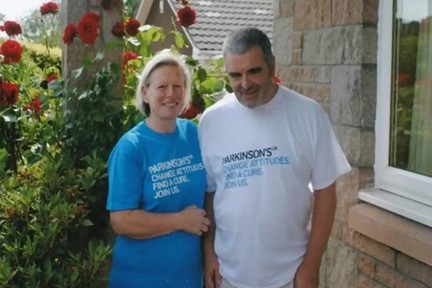
Joy with her husband Les Milne. Credit: Joy Milne
She says of her husband’s Parkinson’s Disease symptoms, what it was like living with Parkinson’s and its effect on their children: “Their father had changed quite a bit by the time they realised.
“That change of character, the violent dreams. Les became the opposite.”
What’s it like to care for someone with Parkinson’s?
Joy repeats the words of another when she says “Caring for Parkinson’s is not for the light-hearted. It is quite a difficult job.
“He understood at the very end.
“One day he turned around, put me in his arms and said ‘I have really made it very difficult for you. I’m really sorry’.
“But that was the disease, that wasn’t my Les.
There are two different people I have lived with. I’ve lived with my Les and I’ve lived with someone with Parkinson’s.”
Les died of Parkinson’s at the age of 45.
Before Les passed away, he made Joy promise to work with scientists to ensure her smelling abilities could help with earlier diagnosis of Parkinson’s.
How is Parkinson’s diagnosed? Joy’s test
Joy kept her promise and has helped Dr Perdita Barron at Manchester University develop a simple 3-minute swab test that can identify Parkinson’s.
After swabbing sebum from the back of a person’s neck (the part of the body where she can smell Parkinson’s most), volatile compounds identified as Parkinson’s are analysed in a mass spectrometer machine.
Joy is then able to sniff out the compounds that are linked to the condition.
She says there are four different levels of intensity of the disease and a T-shirt test saw her correctly identify T-shirts worn by 12 people diagnosed with Parkinson’s.
She also surprised scientists by identifying a thirteenth person as having Parkinson’s. That individual was part of the control group but eight months later he was diagnosed with Parkinson’s.
Is Joy’s sense of smell more powerful than a trained animal?
After helping develop a swab test for Parkinson’s to enable earlier diagnosis, Joy did not stop there.
Her heightened smelling sense took her to Tanzania – the base of Apopo’s Training and Innovation headquarters in Tanzania.
Apopo trains scent detection animals including ‘HeroRATs’ and dogs to rid the world of tuberculosis (TB) as well as landmines.
10 million people contract TB every year, three million go undiagnosed, and 1.8 million die from the disease.
‘I did score higher than the rat’
Joy’s super sense made her out-sniff a trained TB detection rat – the African giant pouched rat (Cricetomys ansorgei).
She says: “I did score higher than the rat”. After beating the rat, Joy is now working on a simple test for early diagnosis of TB (tuberculosis).
Joy is an honorary lecturer at University of Manchester.
She urges people to look up PD Avengers.
She says: “I am part of the PD Avengers. We are a body of people who are advancing the work in Parkinson’s.
“On his death bed he made me promise that I would do this”, Joy adds.
“To the extent that I am doing now we never, ever thought about. To get to this stage, he would be so pleased, he really would.”
You can listen to Joy Milne tell her story in Episode 30 of the Let’s Talk About Care podcast
FAQs
What is Parkinson’s?
Parkinson’s is a neurological, progressive disease which gets worse over time and causes problems in the brain. It can affect a person’s movement and thinking processes, as well as creating other physical and psychological symptoms. People with Parkinson’s don’t have enough of the chemical dopamine in their brain because some of the nerve cells that make it have died.
What are the symptoms of Parkinson’s?
Symptoms of Parkinson’s can include tremor (involuntary shaking of parts of the body), slowness of movement, muscle stiffness. Other common symptoms can include depression, sleeping problems and pain. People with Parkinson’s can also experience balance issues and a loss of sense of smell (anosmia).
What is hyperosmia?
Hyperosmia is an overwhelming sensitivity to smells. It is a rare condition.
Find a care home near you
Search for care homes near you, compare fees, and read reviews from families to help you choose.