
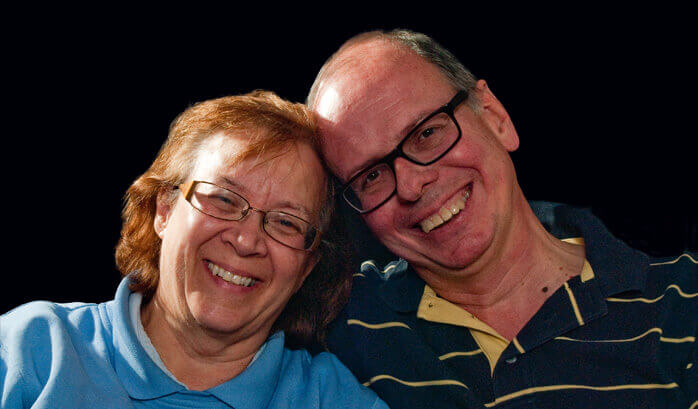
Image credit: David Shepherd
Page contents
Page contents
My husband has dementia, what help can I get?
Losing the person you love to dementia can be devastating. Dementia is very cruel. It gradually destroys memory and thinking skills, leaving people unable to remember their family and friends.
You are faced with losing the person you know and love, your relationship as you know it and the future you dreamed of.
Unlike bereavement, this loss happens gradually. Your partner may still be physically present, yet emotionally, and psychologically absent. This experience is often described as ambiguous loss, and it can leave partners feeling isolated, guilty, and unsure how to cope.
This article offers practical advice for those who feel they are ‘losing’ their partner to dementia, while still caring for them day by day.
Understanding dementia grief and ambiguous loss
Dementia causes a type of grief known as ambiguous loss. This means you are grieving someone who is physically present but psychologically or emotionally absent. Unlike bereavement, there is no clear ending, which can make the grief feel ongoing and unresolved.
Common feelings include:
- Grieving for your partner while they are still alive
- Feeling lonely despite living together
- Missing emotional closeness and companionship
- Feeling guilty for wanting your old relationship back
This type of grief is common among dementia carers in the UK, yet it is often misunderstood and rarely talked about openly.
Accepting that dementia changes your relationship
As dementia progresses, your relationship will change. Your partner may no longer be able to:
- Hold meaningful conversations
- Share decisions with you
- Offer emotional support
- Remember memories you have shared
Accepting this change does not mean you love them any less. It means recognising the reality of dementia and allowing yourself to adjust expectations. Many partners find that letting go of ‘how things used to be’ helps reduce emotional pain over time.
Coping with guilt as a dementia carer
Guilt is one of the most common emotions experienced by partners of people living with dementia. You may feel guilty for:
- Feeling frustrated or resentful
- Wanting time to yourself
- Thinking about residential care or
- Mourning the relationship you have lost
Provides 24-hour care from qualified nurses, alongside accommodation and personal care, for individuals with complex medical needs, severe disabilities, or chronic illnesses.
These feelings do not make you a bad partner or carer. They are a natural response to a long-term, emotionally demanding situation. In the UK, many carers benefit from speaking to a GP, counsellor, or carer support service about these emotions.
Balancing being a partner and a carer
Dementia often turns spouses into full-time carers. This shift can feel overwhelming and can change the balance of power and intimacy in the relationship.
Helpful strategies include:
- Accepting help from family, friends, or social services
- Using respite care when available
- Separating caring tasks from companionship
- Maintaining your own interests and identity
You are still a partner, not just a carer.
Loneliness and isolation for partners of people with dementia
Many people caring for a partner with dementia feel isolated. Friends may not understand why you are grieving.
To reduce isolation:
- Join a UK dementia support group (local or online)
- Connect with other carers through charities such as Dementia UK or Age U
- Try and talk openly with your friends
- Seek professional counselling if possible
Being heard and understood can make a significant difference.
David shares his story
David Shepherd whose wife Catriona lives with dementia at Heanton Nursing Home in Barnstaple has shared his story of what it is like to lose your partner to dementia.
“In the two or three years before my wife, Catriona’s, diagnosis it was challenging. Initially, I didn’t think there was anything medically wrong and I still carry enormous guilt that I didn’t realise sooner.
I found I often got angry and frustrated when Catriona forgot things, I just thought she wasn’t concentrating but needless did I know she was already struggling, and my reactions must have made things even scarier for her.
One day she drove to the supermarket and couldn’t park the car, I really didn’t understand why, but it became more apparent that there was an underlying issue.
The struggle was in getting her to admit it and accept that she needed to see the doctor. It took over 6 months of gentle persuasion to take Catriona to her first appointment.
On receiving her diagnosis, ‘I felt an overwhelming surge of emotions’
Catriona was finally diagnosed with early-onset Alzheimer’s in 2014 after a long and tortuous process. When we received the diagnosis, I felt an overwhelming surge of emotions.
I was filled with what felt like a torrential downpour of desperation mingled with a glimmer of relief. The desperation I felt within me came with floods of tears, as I knew that this cruel illness would relentlessly steal away the person I love and cherish.
Catriona never really accepted that she had the illness and so life continued to be a struggle and I felt that I was walking on eggshells every time we came close to talking about it.
‘Everything changes when your partner has dementia’
Everything changes when your partner has Alzheimer’s. Eventually, you become a full-time carer – and that really does mean 24 hours a day. It’s exhausting but I had no choice. Catriona wasn’t safe to be left on her own for a moment.
By that point, you can’t go out because they can’t go out. My world became as small as hers – just our four walls.
We were fortunate that the diagnosis took place at the National Hospital for Neurosurgery in London, as they are the experts in dementia. After the diagnosis, we had some time with a nurse, who gave us guidance on what to expect, where to go for support and answered any questions we had, it was very comprehensive.
We had twice-a-year appointments at the hospital, and visits from various people from the local Memory Clinic, to monitor the progress of the condition. Catriona even got involved in some research projects. We were directed to a local charity that specialised in young people living with dementia. This provided a helpful support group along with activities for Catriona.
After moving, the level of support changed
When we embarked on our journey to move to Devon in 2015, the level of support drastically changed. My heart sank as we walked into the office of our new GP, with hope filling our hearts for a similar level of help.
We poured out our worries and concerns, seeking assistance. But the words that came from the GP struck us with devastation, leaving us shattered and disheartened. The GP said there was nothing he could do to help other than signpost us to the Alzheimer’s Society. So, life continued on, taking each day as they came trying to live as normal life as we possibly could.
‘I made the heartbreaking decision to move Catriona into a care home’
In the summer of 2020, I made the heartbreaking decision to move Catriona into a care home which was one of the toughest decisions I’ve ever had to make. It came to a point, the place we had called home for many years, a place full of love and memories, our sanctuary, was no longer the safest place for her.
That remains engraved in my memory as the saddest, toughest day of my life.
The team at Heanton Nursing Home arranged video calls, as the UK was in a lockdown due to Covid, that offered a glimpse into her world. But in truth, those virtual encounters could never replace the warmth of her presence, the touch of her hand and the comfort of being by her side.
I would sometimes find myself by the river in Bideford, looking up and across in the direction of Heanton and thinking about her, wondering how she was and what she was doing.
Once visits were possible, that definitely helped me deal with the transition, as it started to lift some of the guilt that I was feeling about having sent her off to live in a care home.
Losing your partner to dementia ‘is undeniably challenging’
Losing your partner to dementia and navigating the journey of caring for them is undeniably challenging.
A spokeswoman for Heanton Nursing Home said: “We wholeheartedly understands the immense struggles that Alzheimer’s disease brings to the lives of those affected and their loved ones.
David visits Catriona most days, sometimes bringing his band to play music which brings solace and joy to her and other family members within the home.
At Heanton, our commitment extends beyond our family members; we embrace the opportunity to be a guiding light for their loved ones, offering unwavering support as they navigate the complex and emotional journey Alzheimer’s brings.”
You can listen to John and Nula Suchet talking about what it is like having a partner with dementia on carehome.co.uk’s Let’s Talk About Care podcast.